
Initiatives for Environment
Environmental Targets
CIM has formulated the "Energy Conservation Policy", the "Greenhouse Gas Emissions Reduction Policy", the "Water Saving Policy", the "Waste Management Policy" and the "Policy for Climate Change Related Issues" which stipulate efforts to reduce environmental impact in real estate investment management operations. Through the cycle of planning, implementation, performance management, and improvement set forth in the "Environmental Management System (EMS) Operation Manual" that stipulates the details for operating these policies, CIM will strive to continuously reduce the environmental impact.
In accordance with the Act on the Rationalization etc. of Energy Use (Energy Conservation Act), CIM sets the following quantitative targets for the continuous reduction of energy consumption throughout the portfolio.
- Long-term target 1: Reduce annual (Note 1) energy consumption intensity within the owner management scope (Note 2) by 5% in 2029 from 2024 levels
- Long-term target 2: Reduce the annual energy consumption intensity within the tenant management scope (Note 3) by 1% in 2029 from 2024 levels
Regarding greenhouse gas emissions, in accordance with the reduction target for energy consumption, the basic target for the scope 1+ scope 2 (Note 4) is to reduce the emission intensity by 5% in 2029 from 2024 levels. The basic target for the scope 3 (Note 5) and the scope 1+ scope 2+ scope 3 is to reduce the emission intensity by 1% in 2029 from 2024 levels.
Regarding water usage and waste volume, our target is not to increase each intensity level in the five years from 2025 to 2029 compared to 2024 levels.
The Sustainability Committee compares target and actual values and appropriately considers measures to achieve each environmental target. The scope of the initiatives for reducing energy consumption and greenhouse gas emissions is the energy consumption through the use of lighting, air conditioning, and various facilities in INV's portfolio, specifically refers to 1) purchased electricity, 2) city gas/LP gas, etc., 3) heavy oil/kerosene/gasoline, etc., and 4) purchased steam, hot and cold water, and district heating and cooling etc. consumed on-site. For previously disclosed data, please refer here.
Energy Consumption Intensity (MWh/㎡)
| 2024 (Base Year) |
2025 | Owner Management Scope (Note 1) | 0.065 | 0.061 |
|---|---|---|---|
| Change from Base Year | - | 93.8% | |
| Tenant Management Scope (Note 2) | 0.312 | 0.316 | |
| Change from Base Year | - | 101.3% | |
Greenhouse Gas Emission (t-CO2eq) and Intensity (t-CO2eq/㎡)
| 2024 (Base Year) |
2025 | ||
|---|---|---|---|
| Scope 1 (Note 4) | Total Amount | 14 | 15 |
| Intensity | 0.000 | 0.000 | |
| Scope 2 (Note 3) (Location Basis) |
Total Amount | 598 | 555 |
| Intensity | 0.026 | 0.024 | |
| Scope 2 (Note 4) (Market Basis) |
Total Amount | 476 | 532 |
| Intensity | 0.021 | 0.023 | |
| Scope 1 + Scope 2 (Location Basis) | Total Amount | 612 | 570 |
| Intensity | 0.027 | 0.025 | |
| Change from Base Year | - | 92.6% | |
| Scope 1+ Scope 2 (Market Basis) | Total Amount | 490 | 547 |
| Intensity | 0.021 | 0.024 | |
| Change from Base Year | - | 114.3% | |
| Scope 3 (Note 5) | Total Amount | 94,234 | 100,421 |
| Intensity | 0.099 | 0.097 | |
| Change from Base Year | - | 98.0% | |
| Scope 1 + Scope 2 (Location Basis) + Scope 3 | Total Amount | 94,846 | 100,991 |
| Intensity | 0.098 | 0.095 | |
| Change from Base Year | - | 96.9% | |
| Scope 1 + Scope 2 (Market Basis) + Scope 3 | Total Amount | 94,724 | 100,968 |
| Intensity | 0.098 | 0.095 | |
| Change from Base Year | - | 96.9% | |
Water Withdrawal Intensity (㎥/㎡) and Waste Volume Intensity (t/㎡)
| 2024 (Base Year) |
2025 | Water Withdrawal Intensity | 3.900 | 3.912 |
|---|---|---|---|
| Change from Base Year | - | 100.3% | |
| Waste Volume Intensity | 0.009 | 0.010 | |
| Change from Base Year | - | 111.1% | |
- (Note 1)
- January to December of the same year.
- (Note 2)
- In principle, the owner management scope refers to common areas of residences owned by INV.
- (Note 3)
- In principle, the tenant management scope refers to whole area of hotels and retail facilities and tenant-exclusive areas of residences owned by INV.
- (Note 4)
- Scope 1 covers direct greenhouse gas emissions from fuel consumption within the owner management scope, and Scope 2 covers indirect greenhouse gas emissions from electricity, heat, etc. purchased within the owner management scope. In addition, the target properties are those that (i) were held throughout the aggregation period and (ii) have data that enables comparison under the same conditions. Adjustments based on occupancy rates will be made on the actual values. Hereinafter the same.
- (Note 5)
- Scope 3 covers greenhouse gas emissions derived from tenant management scope.
Environmental Management System (EMS)
EMS Policy
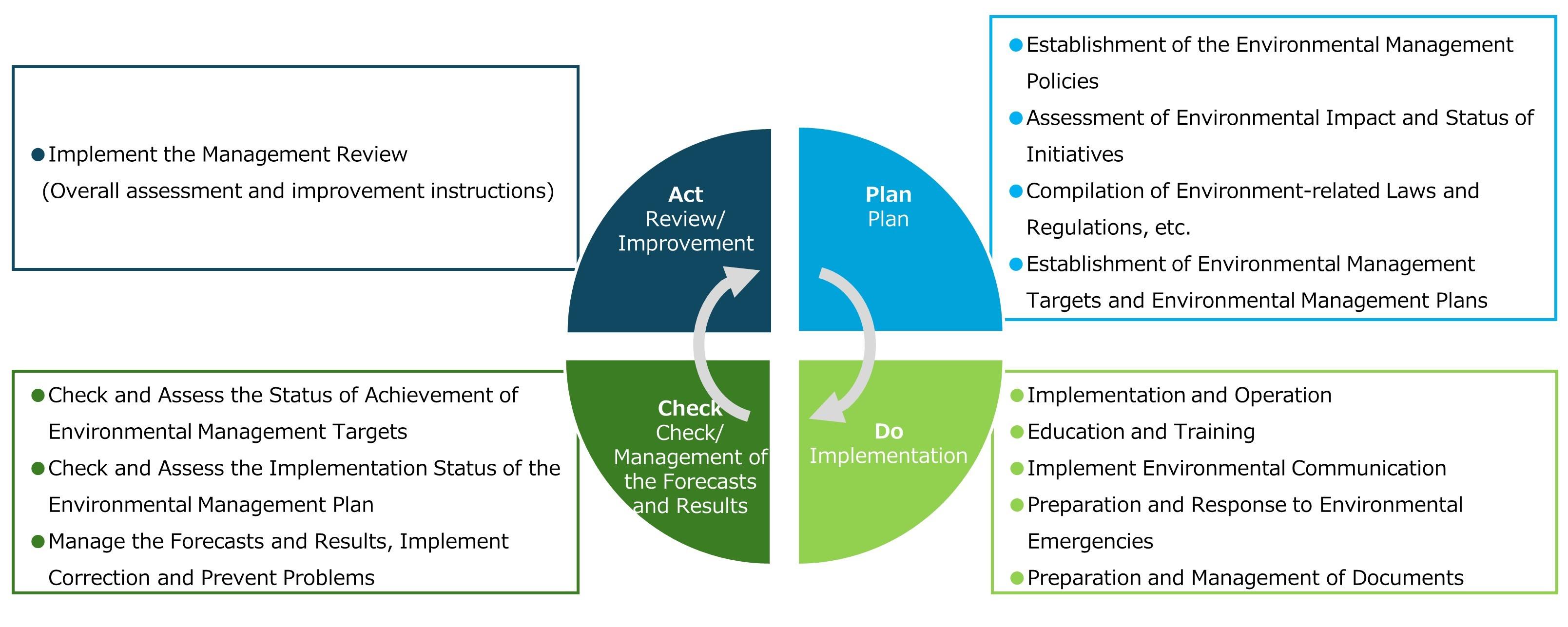
CIM recognizes energy conservation and reduction of GHG emission and others as important environmental issues for our real estate portfolio and is committed to addressing these issues in our sustainability policy. CIM has developed the "energy conservation policy", "GHG emission reduction policy", "water-saving policy" and "waste management policy" which define initiatives toward the reduction of environmental impact in the real estate investment management business. Furthermore, CIM has been working to reduce our environmental impact through PDCA (Plan/Do/Check/Act) cycle based on our EMS policy which specifies the details for managing these policies.
EMS diagram based on PDCA Cycle
Environmental Performance
The environmental performance of INV's portfolio for each year (January to December) is as follows. For previously disclosed data, please refer here.
| 2024 (Note 3) |
2025 (Note 3) |
|||
|---|---|---|---|---|
| Coverage Ratio (Note 4) |
||||
| Number of Target Properties (Note 1) | 146 | 156 | - | |
| Energy Consumption | Total Amount (MWh) |
296,629 | 328,725 | 92.3% |
| Intensity (MWh/㎡) |
0.307 | 0.311 | ||
| Renewable Energy (MWh: included in total amount) |
- | - | -% | |
| Greenhouse Gas Emissions |
Total Amount (t-CO2eq) |
94,723 | 100,968 | 92.3% |
| Intensity (t-CO2eq/㎡) |
0.098 | 0.095 | ||
| Water Withdrawal | Total Amount (㎥) |
3,767,821 | 4,133,109 | 92.8% |
| Intensity (㎥/㎡) |
3.900 | 3.912 | ||
| Waste Volume | Total Amount (t) |
7,849 | 9,753 | 87.8% |
| Intensity (t/㎡) |
0.009 | 0.010 | ||
| Recycling Rate (Note 2) (%) |
18.0 | 16.9 | ||
- (Note 1)
- Properties acquired or sold during the relevant period are included.
- (Note 2)
- Recycling rate (%) is calculated by dividing the recycled weight (t) by the total weight of waste (t).
- (Note 3)
- Actual value of each property is based on the data during the holding period by INV. For co-ownership properties, actual value of the entire property is reported regardless of INV's ownership ratio.
- (Note 4)
- Coverage ratio (%) is calculated by dividing floor area of the portion where the data was collected (㎡) by total floor area (㎡).
Initiatives for Green Buildings
In order to promote initiatives for green buildings, the real estate that is environmentally and socially friendly, INV has implemented the following renovations in our portfolio and introduced effective equipment to reduce environmental impact, such as promoting energy conservation, reducing CO2 emissions, and effectively utilizing water resources.
- Introduction of large-scale energy-saving equipment (cold/hot water generator, hot water heater, etc.)
- Water saving by recycling pool drainage
- Introduction of LED lighting
- Introduction of the water-saving type toilet
- Installation of a water-saving shower
- Installation of gas cogeneration, inverter, etc.
- Automatic meter readings (AMR)
- Introduction of BEMS
- Installation of high-efficiency equipment and appliances
- Introduction of on-site renewable energy
Green Leases
Green lease is an initiative in which owners and tenants of a real estate asset voluntarily agree in a lease contract to work together on measures related to the environmental consideration of the real estate and put them into practice. INV has been actively adopting green lease and, together with the agreed tenants, has been actively maintaining and improving the environmental performance of INV's properties.
| End of June 2025 |
End of December 2025 |
Change | |
|---|---|---|---|
| Number of Properties under Green Lease Agreements | 97 (out of 146 total properties) |
107 (out of 156 total properties) |
+10 |
| Conclusion Rate (Gross floor area basis) | 73.0% | 75.2% | +2.2pt |
Distribution of Sustainability Guides for Tenants
We distribute examples of initiatives on "sustainable hotel management" to hotel operators, who are tenants, and encourage them to work to reduce the environmental impact of hotel management and raise environmental awareness among guests.
Introduction of Energy-Saving Equipment
INV has been implementing various initiatives to promote energy savings and CO2 reduction related to hotel operations in the surrounding areas.
Energy-Saving Construction using Government Subsidies
INV collaborates with INV's main tenant, Iconia Hospitality K.K. ("ICN") to promote energy efficient renovation projects through the effective use of the subsidies provided by the government. At properties owned by INV, energy saving renovations supported by subsidies from the Ministry of Economy, Trade and Industry have been implemented at two hotels (Hotel Epinard Nasu and Art Hotel Niigata Station). In addition, energy saving and other environmentally focused renovation projects supported by subsidies from the Ministry of the Environment have been implemented at nine hotels(Kamenoi Hotel Beppu, Hotel MyStays Sapporo Aspen, Hotel Nord Otaru, Hotel MyStays Nagoya-Sakae, Hotel MyStays Ueno East, Hotel Epinard Nasu, Hotel MyStays Gotanda Station, Kirishima Kokusai Hotel and Art Hotel Kokura New Tagawa).
INV and ICN aim to reduce both CO2 emissions and running costs by leveraging subsidies such as the SHIFT Project (Note 1) , etc.
Kamenoi Hotel Beppu
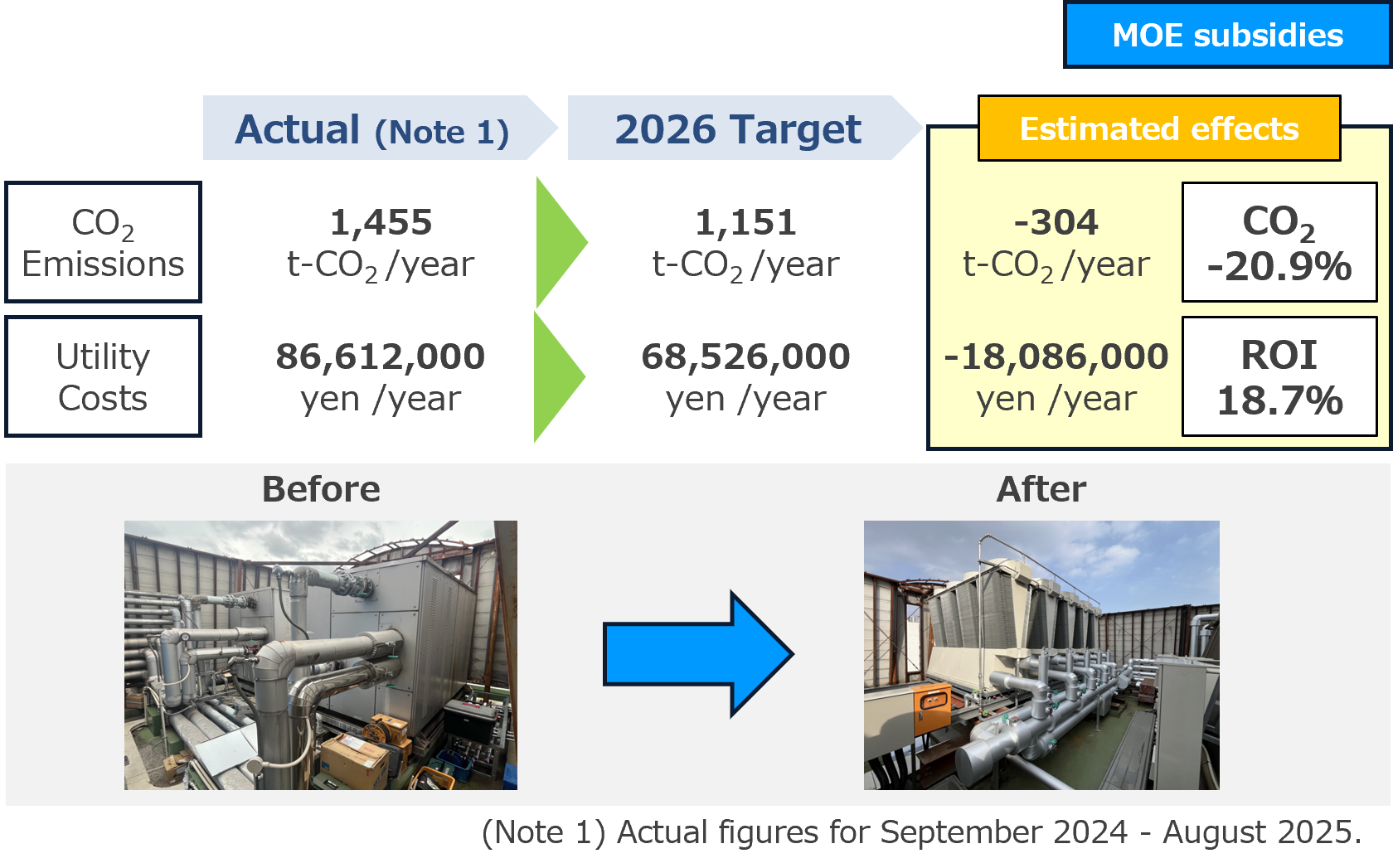
Kamenoi Hotel Beppu received a subsidy of JPY 36.4 million (about one-third of the total investment) from the Ministry of the Environment's SHIFT Project to remove its aging heavy oil-fired hot water boilers that were due for renewal and install a hybrid hot water/heating system and high-efficiency air conditioning system.
Hotel MyStays Sapporo Aspen and Hotel Nord Otaru
Hotel MyStays Sapporo Aspen and Hotel Nord Otaru received subsidies of JPY 24.9 million in total (about one-third of the total investment) from the Ministry of the Environment's SHIFT Project to remove absorption water cooling and heating machines which were due for replacement, and introduced air cooled heat pump chillers in the aim to reduce CO2 emissions.
Hotel MyStays Nagoya-Sakae, Hotel MyStays Ueno East, Hotel Epinard Nasu and Hotel MyStays Gotanda Station
Hotel MyStays Nagoya-Sakae, Hotel MyStays Ueno East, Hotel Epinard Nasu and Hotel MyStays Gotanda Station received subsidies of JPY 99.8 million in total (about one third of the total investment) from the Ministry of the Environment's SHIFT Project to replace oil and gas-fired boilers and other equipment with systems that have a lower environmental impact and higher energy efficiency.
Kirishima Kokusai Hotel
Kirishima Kokusai Hotel received a subsidy of JPY 53.5 million (about one-third of the total investment) from the Ministry of the Environment's National Park Facility Decarbonization Promotion Project to upgrade the air conditioning system that uses steam from natural hot springs on-site.
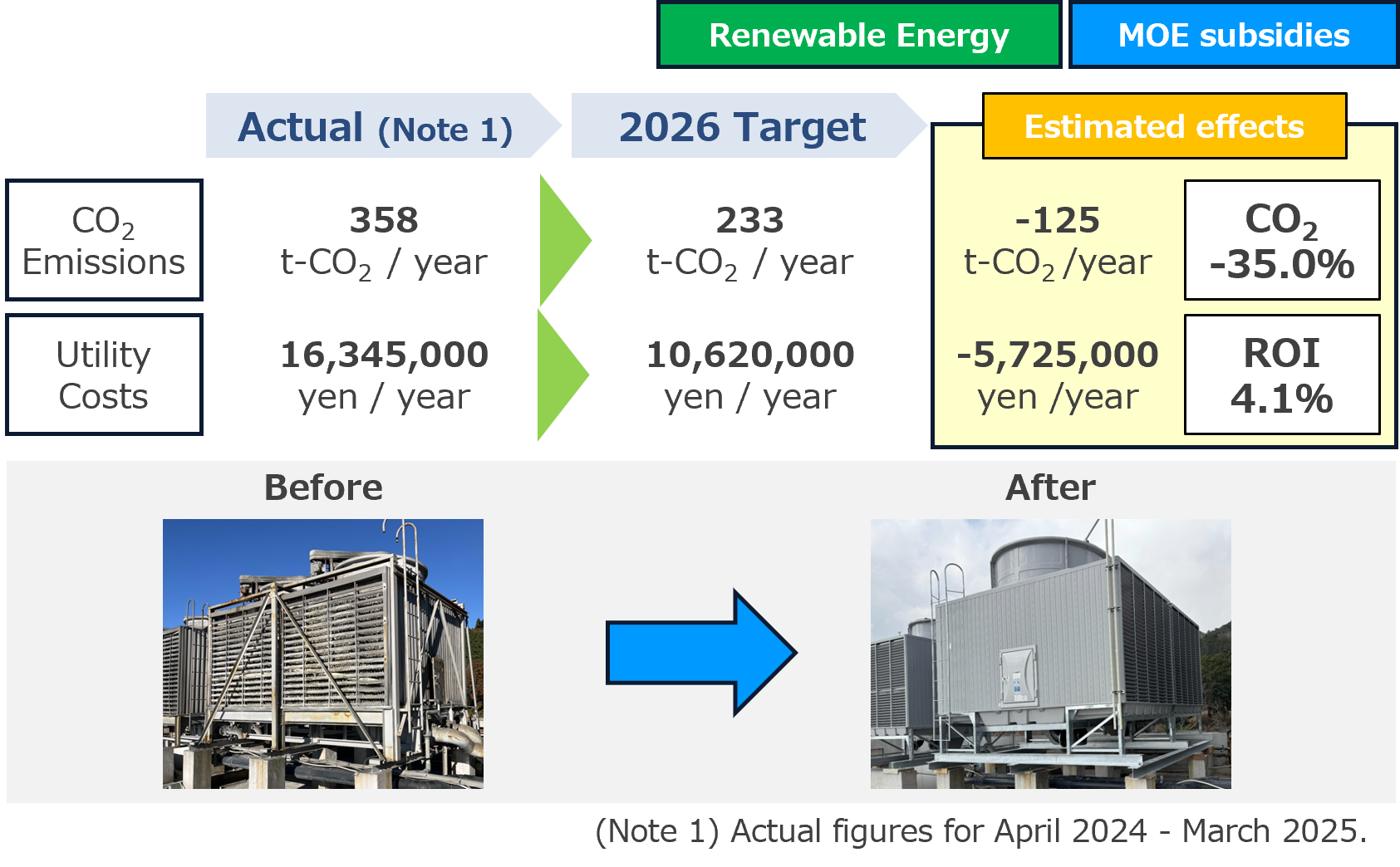
Art Hotel Kokura New Tagawa
Art Hotel Kokura New Tagawa received a subsidy of JPY 36.8 million (about one-third of the total investment) from the Ministry of the Environment's SHIFT Project to remove a heavy oil-fired hot water boiler that was due for renewal and installed a hybrid hot water/heating system and high-efficiency air conditioning system.
- (Note 1)
- Projects that support initiatives that serve as role models for decarbonization (setting reduction targets, formulating reduction plans, and implementing facility upgrades, electrification, fuel conversion, and operational improvements) at factories and business sites with the aim of achieving Japan's 2030 GHG reduction targets and achieve carbon neutrality by 2050.
Energy-Saving and Energy-Efficiency Construction work
INV and ICN implemented LED conversion work and renewal work of air-conditioning system, etc. at seven hotels owned by INV in 2025 to realize energy saving and reduce energy cost.
LED conversion work
Property Name
Details of work
Estimated annual
electricity cost savings
ROI
Hakodate Kokusai Hotel
West Wing corridors, banquet hall, back-of house
JPY 9,043,000
25.1%
Hotel MyStays
Premier Sapporo Park
Indoor emergency evacuation staircase
JPY 943,000
14.5%
Hotel MyStays
Sapporo Aspen
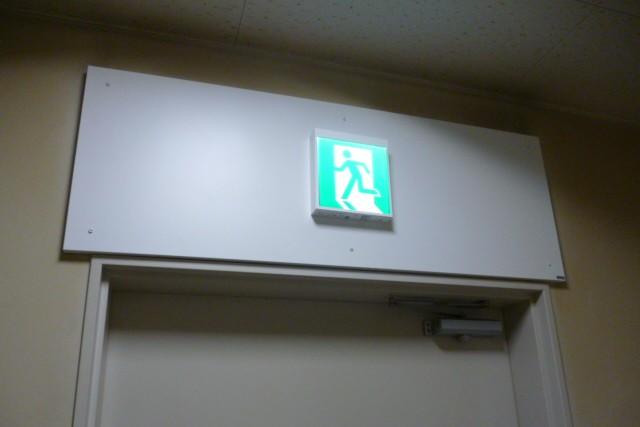
Emergency exit sign
JPY 658,000
9.7%
Hotel MyStays
Hakodate-Goryokaku
Indoor emergency evacuation staircase
JPY 287,000
10.6%
Hotel MyStays
Sapporo Station
Emergency exit sign
JPY 247,000
9.0%
Hotel MyStays Sapporo Aspen
Before
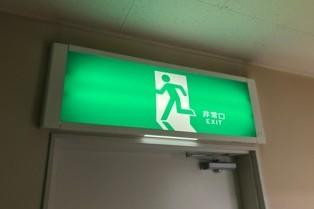
After
Renewal work of air-conditioning system, etc.
Property Name
Details of work
Estimated annual electricity cost savings
ROI
Estimated annual CO2 emission reduced
Hotel MyStays
Sapporo Station
Implementing renewal work in four phases to replace GHP (gas heat pump) with EHP (electric heat pump) (all four phases completed)
JPY 7,557,000
(Note 1)
1.8%
147,900kg
MyStays Shin-Urayasu
Conference Center
Upgraded guestroom air conditioning systems
JPY 774,000
3.2%
18,537kg
Art Hotel Joetsu
Upgraded air conditioning systems in the wedding shrine on the third floor
JPY 178,000
7.4%
3,981kg
Upgraded air conditioning systems in the photo studio on the
third floor
JPY 178,000
7.1%
3,981kg
Upgraded air conditioning systems in foyer on the second floor
JPY 123,000
7.9%
2,855kg
- (Note 1)
- Estimated amount after all phases completed.
Initiatives by Hotel Operator
INV and ICN, the main operator of hotels owned by INV have been implementing various initiatives to promote energy savings and CO2 reduction related to hotel operations and to preserve biodiversity in the surrounding areas.
Various Initiatives for Energy Conservation and CO2 Reduction
- Eco-friendly plan at hotel "ECO-Plan"
Encouraging guests to use eco-friendly plans by lowering the price of plans that do not require linen exchange when guests stay 7 consecutive nights
- Conducted energy-saving checks
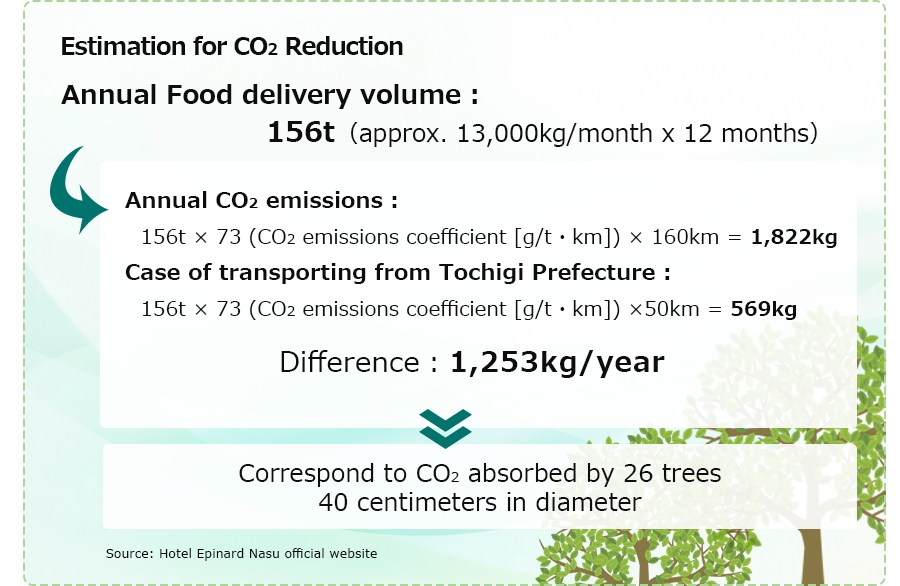
- Reducing greenhouse gas emissions from Food Transportation at Hotels (Hotel Epinard Nasu)
Contributing to CO2 reductions by cooperating with farmers and dairy farmers in Tochigi Prefecture to reduce the procurement from prefectures other than Tochigi
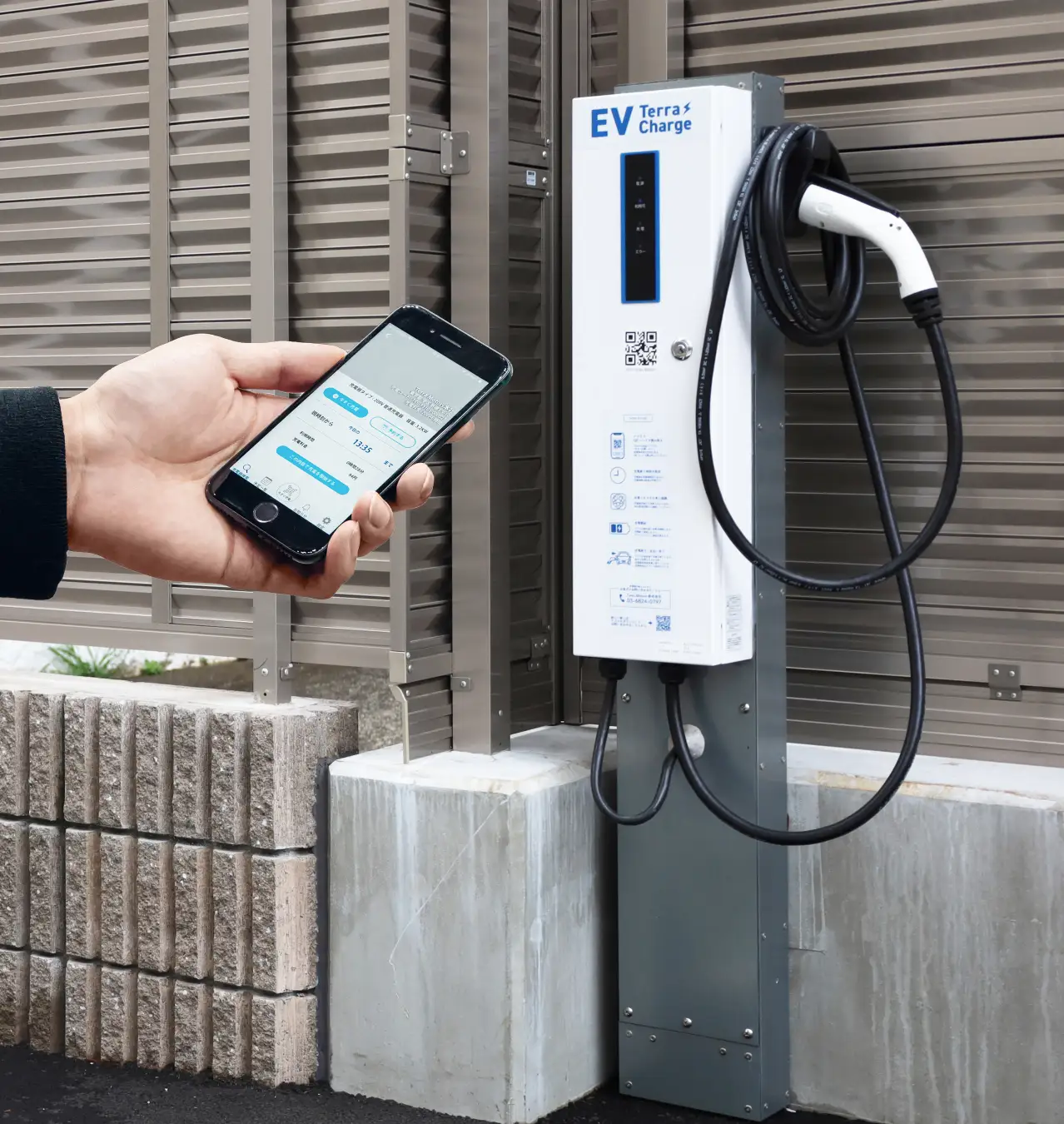
Introduction of EV infrastructure "Terra Charge"
Decided to introduce EV charging infrastructure "Terra Charge" provided by Terra Motors Corporation in most of hotels operated by ICN as one of the measures to achieve a decarbonized society. 157 units have been installed at 91 hotels as of the end of April 2026, and further 16 hotels plan to install units in 2026 to protect the environment and improve convenience of hotel guests.
Hotel brand
# of hotels to be
introduced
# of units to be
introduced
Hotel MyStays Premier
4
7
Hotel MyStays
23
34
Flexstay Inn
0
0
Art Hotel
9
15
Iconia Collection
18
29
Kamenoi Hotel
37
72
Total
91
157
- (Note 1)
- Due to hotel rebranding and other factors, the historical number of hotels and installed units for each brand may be subject to change.
Biodiversity Initiative
Hotel Epinard Nasu
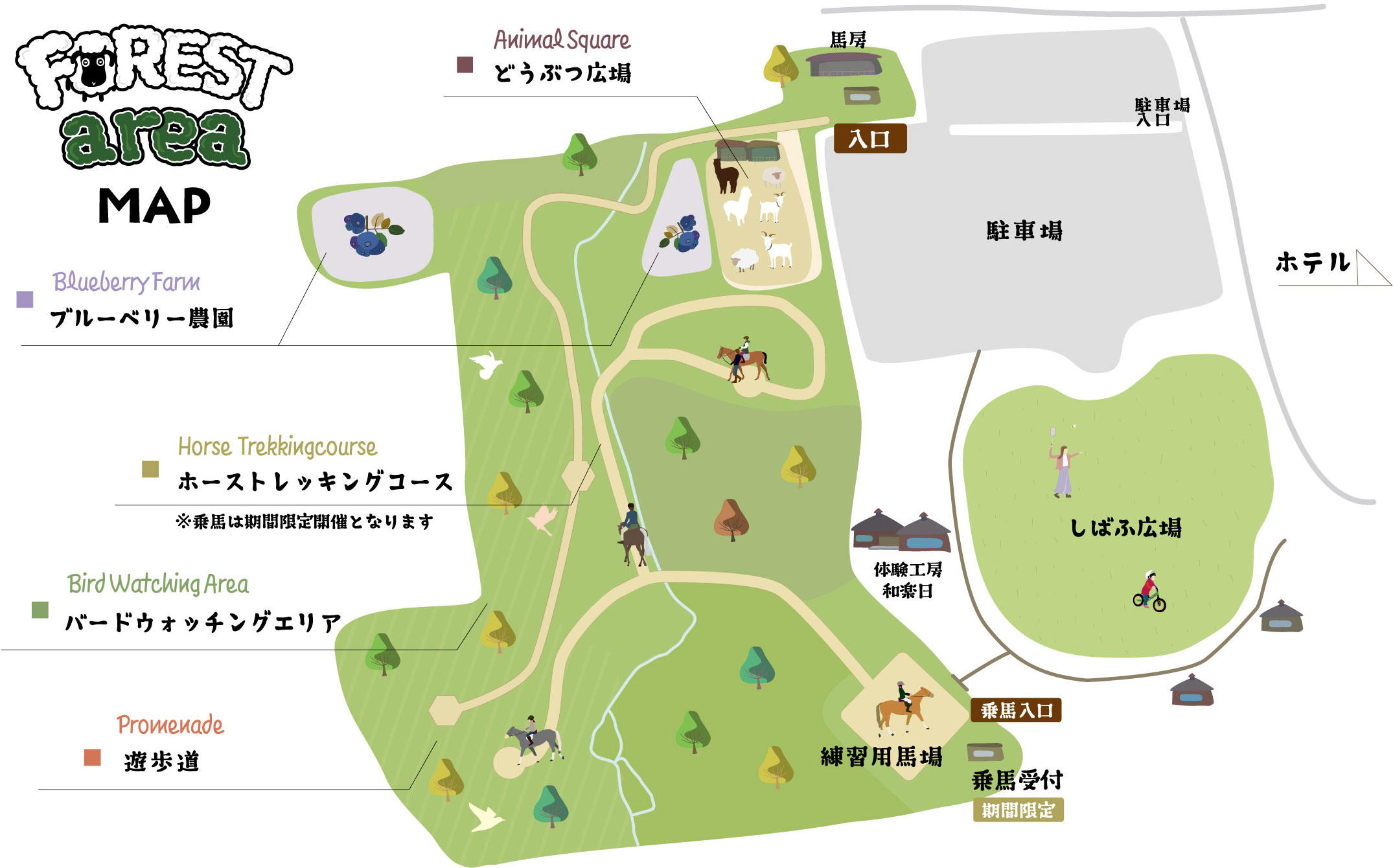
In order to reduce the impact of deforestation on the ecosystem, tree felling was minimized during hotel development. In the blueberry farm area, we are working to conserve the forest by planting more blueberries than were cut down. Furthermore, hotel provides the activities and nature tours that guests can enjoy in the rich natural forest which is home to insects and small animals.
Art Hotel Ishigakijima
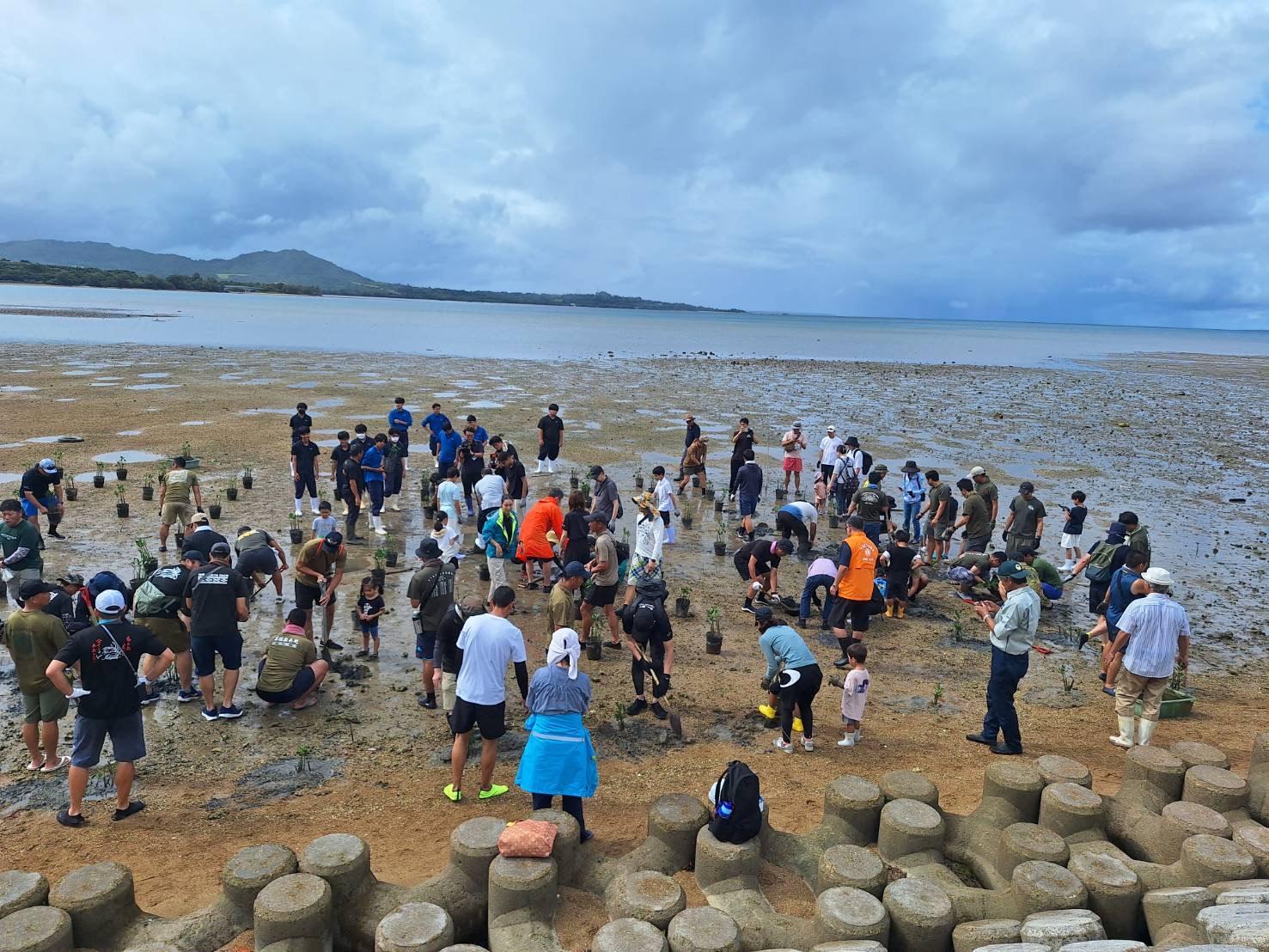
Participated in forestation activities of mangroves organized by Lions Club of local area. It is said that mangrove helps to reduce effect of global warming by absorbing CO2 and store carbon which are main factor of global warming. Furthermore, it also serves as a "green breakwater" that protects people's lives and ecosystems from natural disasters such as tidal waves and tsunamis.
Fusaki Beach Resort Hotel & Villas
With the aim of preserving the rich nature of Ishigaki Island, from June 13, 2022, we are replacing toothbrushes and hairbrushes made with 100% plant derived materials that biodegrade in seawater. In addition, the razors provided to guests have been replaced by the ones containing renewable biological resources consisting of waste parts of wheatgrass. Furthermore, plastic packaging was changed to paper packaging in the aim of reducing the amount of plastic waste.

Phoenix Seagaia Resort (Note 1)
Under its sustainability vision, "A resort that revitalizes both people and the planet," the resort conducts annual beach clean-up activities, "Seagaia Beach Clean in Hitotsuba," along the Hitotsuba Coast. These activities are carried out prior to the nesting season of loggerhead sea turtles--designated as a natural monument (protected species) by Miyazaki Prefecture--to help protect their nesting grounds.
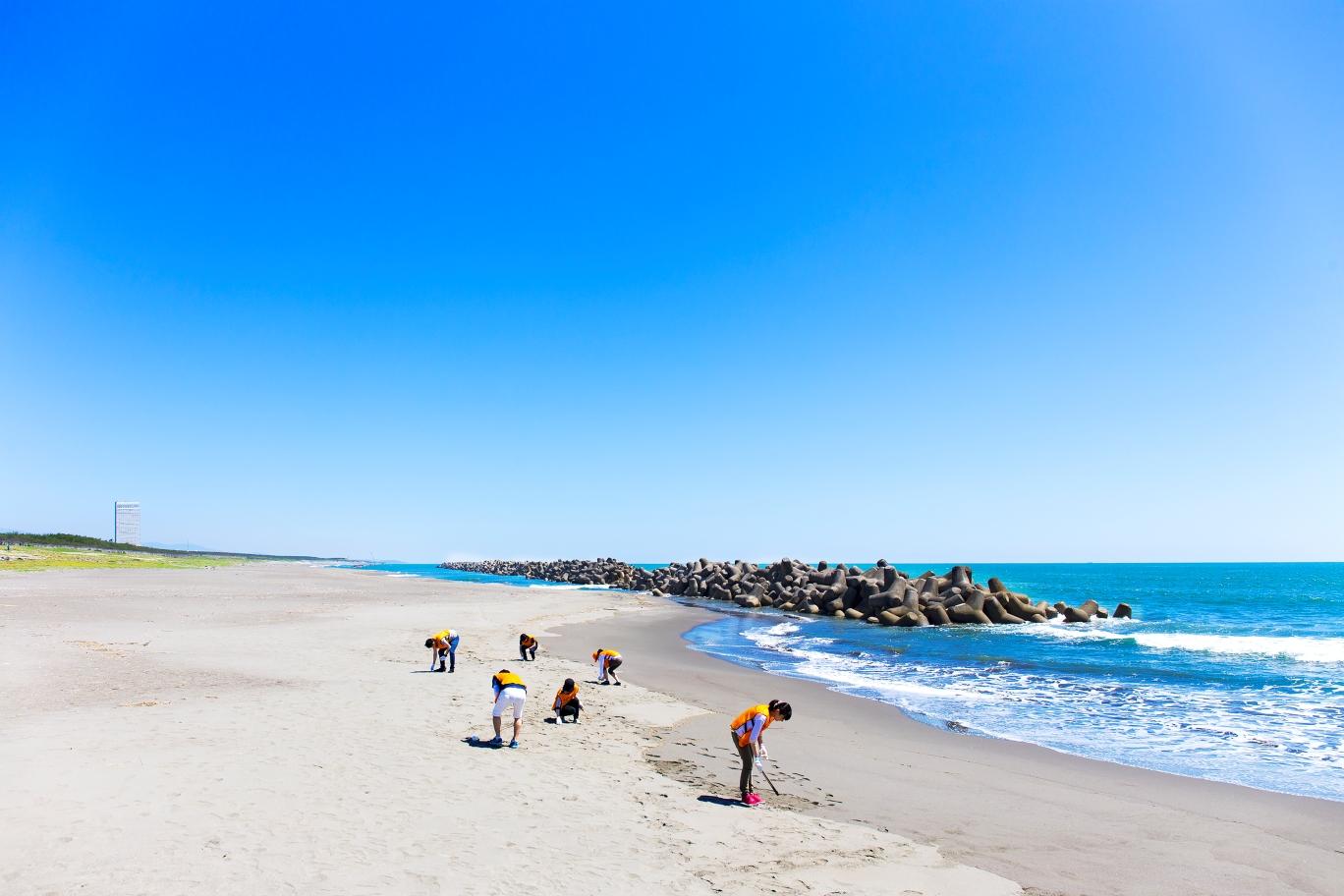
The resort also participates in a project aimed at restoring areas in the Hitotsuba area affected by pine wilt disease, and engages in initiatives such as donating used linens from hotel guestrooms to the nearby Miyazaki City Phoenix Zoo.
- (Note 1)
- Owned by an entity other than INV and operated by ICN as of June 30, 2026.
Initiatives by Other Hotel Operators
Sheraton Grande Tokyo Bay Hotel ("SGTB")
SGTB offers a program for guests to experience "plogging," an activity that combines fitness and environmental conservation which originated in Sweden. The term "plogging" is a combination of the Swedish phrase plocka upp ("to pick up") and "jogging," and refers to a global movement that merges exercise with environmental protection.


This simple yet meaningful activity involves picking up litter while running and has gained popularity worldwide for more than a decade as a new form of sport addressing environmental issues. Guests can participate casually through complimentary rental of plogging kits--including gloves, garbage bags, and guidebooks on the local ecosystem--as well as high-performance running shoes. This experience encourages collaboration between guests and local residents toward shared environmental goals and fosters a sense of collective responsibility to nurture and protect the natural environment. It also provides an opportunity for guests to build deeper connections with the local community while making a positive impact on the surrounding ecosystem during their stay.
The Westin Grand Cayman Seven Mile Beach Resort & Spa
Collaborates with "Beneath the Waves Foundation" who are working with the Cayman Islands Department of Environment to establish a deep-sea marine protected area in The Cayman Trench, the deepest point of the Caribbean Sea, and contributes to ocean conservation through nature-based solutions to climate change. Furthermore, the hotel provides groups and leisure guests an opportunity for turtle releases with "The Cayman Islands Turtle Centre". Sea turtles have a positive impact on the marine ecosystem as well as the beach and dune ecosystems. Turtle releases ensure that the turtle is older when it reaches the water, increasing their survival rate, and contributing to a healthy marine environment.
INV has been implementing various initiatives to promote energy savings and CO2 reduction related to hotel operations in the surrounding areas.
Energy-Saving Construction using Government Subsidies
INV collaborates with INV's main tenant, Iconia Hospitality K.K. ("ICN") to promote energy efficient renovation projects through the effective use of the subsidies provided by the government. At properties owned by INV, energy saving renovations supported by subsidies from the Ministry of Economy, Trade and Industry have been implemented at two hotels (Hotel Epinard Nasu and Art Hotel Niigata Station). In addition, energy saving and other environmentally focused renovation projects supported by subsidies from the Ministry of the Environment have been implemented at nine hotels(Kamenoi Hotel Beppu, Hotel MyStays Sapporo Aspen, Hotel Nord Otaru, Hotel MyStays Nagoya-Sakae, Hotel MyStays Ueno East, Hotel Epinard Nasu, Hotel MyStays Gotanda Station, Kirishima Kokusai Hotel and Art Hotel Kokura New Tagawa).
INV and ICN aim to reduce both CO2 emissions and running costs by leveraging subsidies such as the SHIFT Project (Note 1) , etc.
Kamenoi Hotel Beppu
Kamenoi Hotel Beppu received a subsidy of JPY 36.4 million (about one-third of the total investment) from the Ministry of the Environment's SHIFT Project to remove its aging heavy oil-fired hot water boilers that were due for renewal and install a hybrid hot water/heating system and high-efficiency air conditioning system.
Hotel MyStays Sapporo Aspen and Hotel Nord Otaru
Hotel MyStays Sapporo Aspen and Hotel Nord Otaru received subsidies of JPY 24.9 million in total (about one-third of the total investment) from the Ministry of the Environment's SHIFT Project to remove absorption water cooling and heating machines which were due for replacement, and introduced air cooled heat pump chillers in the aim to reduce CO2 emissions.
Hotel MyStays Nagoya-Sakae, Hotel MyStays Ueno East, Hotel Epinard Nasu and Hotel MyStays Gotanda Station
Hotel MyStays Nagoya-Sakae, Hotel MyStays Ueno East, Hotel Epinard Nasu and Hotel MyStays Gotanda Station received subsidies of JPY 99.8 million in total (about one third of the total investment) from the Ministry of the Environment's SHIFT Project to replace oil and gas-fired boilers and other equipment with systems that have a lower environmental impact and higher energy efficiency.
Kirishima Kokusai Hotel
Kirishima Kokusai Hotel received a subsidy of JPY 53.5 million (about one-third of the total investment) from the Ministry of the Environment's National Park Facility Decarbonization Promotion Project to upgrade the air conditioning system that uses steam from natural hot springs on-site.
Art Hotel Kokura New Tagawa
Art Hotel Kokura New Tagawa received a subsidy of JPY 36.8 million (about one-third of the total investment) from the Ministry of the Environment's SHIFT Project to remove a heavy oil-fired hot water boiler that was due for renewal and installed a hybrid hot water/heating system and high-efficiency air conditioning system.
Energy-Saving and Energy-Efficiency Construction work
INV and ICN implemented LED conversion work and renewal work of air-conditioning system, etc. at seven hotels owned by INV in 2025 to realize energy saving and reduce energy cost.
LED conversion work
| Property Name | Details of work | Estimated annual electricity cost savings |
ROI |
|---|---|---|---|
| Hakodate Kokusai Hotel | West Wing corridors, banquet hall, back-of house | JPY 9,043,000 | 25.1% |
| Hotel MyStays Premier Sapporo Park |
Indoor emergency evacuation staircase | JPY 943,000 | 14.5% |
| Hotel MyStays Sapporo Aspen |
Emergency exit sign | JPY 658,000 | 9.7% |
| Hotel MyStays Hakodate-Goryokaku |
Indoor emergency evacuation staircase | JPY 287,000 | 10.6% |
| Hotel MyStays Sapporo Station |
Emergency exit sign | JPY 247,000 | 9.0% |
Hotel MyStays Sapporo Aspen
Before
After
Renewal work of air-conditioning system, etc.
| Property Name | Details of work | Estimated annual electricity cost savings | ROI | Estimated annual CO2 emission reduced |
|---|---|---|---|---|
| Hotel MyStays Sapporo Station |
Implementing renewal work in four phases to replace GHP (gas heat pump) with EHP (electric heat pump) (all four phases completed) | JPY 7,557,000 (Note 1) |
1.8% | 147,900kg |
| MyStays Shin-Urayasu Conference Center |
Upgraded guestroom air conditioning systems | JPY 774,000 | 3.2% | 18,537kg |
| Art Hotel Joetsu | Upgraded air conditioning systems in the wedding shrine on the third floor | JPY 178,000 | 7.4% | 3,981kg |
| Upgraded air conditioning systems in the photo studio on the third floor | JPY 178,000 | 7.1% | 3,981kg | |
| Upgraded air conditioning systems in foyer on the second floor | JPY 123,000 | 7.9% | 2,855kg |
- (Note 1)
- Estimated amount after all phases completed.
Initiatives by Hotel Operator
INV and ICN, the main operator of hotels owned by INV have been implementing various initiatives to promote energy savings and CO2 reduction related to hotel operations and to preserve biodiversity in the surrounding areas.
Various Initiatives for Energy Conservation and CO2 Reduction
- Eco-friendly plan at hotel "ECO-Plan"
Encouraging guests to use eco-friendly plans by lowering the price of plans that do not require linen exchange when guests stay 7 consecutive nights
- Conducted energy-saving checks
- Reducing greenhouse gas emissions from Food Transportation at Hotels (Hotel Epinard Nasu)
Contributing to CO2 reductions by cooperating with farmers and dairy farmers in Tochigi Prefecture to reduce the procurement from prefectures other than Tochigi
Introduction of EV infrastructure "Terra Charge"
Decided to introduce EV charging infrastructure "Terra Charge" provided by Terra Motors Corporation in most of hotels operated by ICN as one of the measures to achieve a decarbonized society. 157 units have been installed at 91 hotels as of the end of April 2026, and further 16 hotels plan to install units in 2026 to protect the environment and improve convenience of hotel guests.
Hotel brand
# of hotels to be
introduced
# of units to be
introduced
Hotel MyStays Premier
4
7
Hotel MyStays
23
34
Flexstay Inn
0
0
Art Hotel
9
15
Iconia Collection
18
29
Kamenoi Hotel
37
72
Total
91
157
- (Note 1)
- Due to hotel rebranding and other factors, the historical number of hotels and installed units for each brand may be subject to change.
Biodiversity Initiative
Hotel Epinard Nasu
In order to reduce the impact of deforestation on the ecosystem, tree felling was minimized during hotel development. In the blueberry farm area, we are working to conserve the forest by planting more blueberries than were cut down. Furthermore, hotel provides the activities and nature tours that guests can enjoy in the rich natural forest which is home to insects and small animals.
Art Hotel Ishigakijima
Participated in forestation activities of mangroves organized by Lions Club of local area. It is said that mangrove helps to reduce effect of global warming by absorbing CO2 and store carbon which are main factor of global warming. Furthermore, it also serves as a "green breakwater" that protects people's lives and ecosystems from natural disasters such as tidal waves and tsunamis.
Fusaki Beach Resort Hotel & Villas
With the aim of preserving the rich nature of Ishigaki Island, from June 13, 2022, we are replacing toothbrushes and hairbrushes made with 100% plant derived materials that biodegrade in seawater. In addition, the razors provided to guests have been replaced by the ones containing renewable biological resources consisting of waste parts of wheatgrass. Furthermore, plastic packaging was changed to paper packaging in the aim of reducing the amount of plastic waste.
Phoenix Seagaia Resort (Note 1)
Under its sustainability vision, "A resort that revitalizes both people and the planet," the resort conducts annual beach clean-up activities, "Seagaia Beach Clean in Hitotsuba," along the Hitotsuba Coast. These activities are carried out prior to the nesting season of loggerhead sea turtles--designated as a natural monument (protected species) by Miyazaki Prefecture--to help protect their nesting grounds.
The resort also participates in a project aimed at restoring areas in the Hitotsuba area affected by pine wilt disease, and engages in initiatives such as donating used linens from hotel guestrooms to the nearby Miyazaki City Phoenix Zoo.
- (Note 1)
- Owned by an entity other than INV and operated by ICN as of June 30, 2026.
Initiatives by Other Hotel Operators
Sheraton Grande Tokyo Bay Hotel ("SGTB")
SGTB offers a program for guests to experience "plogging," an activity that combines fitness and environmental conservation which originated in Sweden. The term "plogging" is a combination of the Swedish phrase plocka upp ("to pick up") and "jogging," and refers to a global movement that merges exercise with environmental protection.
This simple yet meaningful activity involves picking up litter while running and has gained popularity worldwide for more than a decade as a new form of sport addressing environmental issues. Guests can participate casually through complimentary rental of plogging kits--including gloves, garbage bags, and guidebooks on the local ecosystem--as well as high-performance running shoes. This experience encourages collaboration between guests and local residents toward shared environmental goals and fosters a sense of collective responsibility to nurture and protect the natural environment. It also provides an opportunity for guests to build deeper connections with the local community while making a positive impact on the surrounding ecosystem during their stay.
The Westin Grand Cayman Seven Mile Beach Resort & Spa
Collaborates with "Beneath the Waves Foundation" who are working with the Cayman Islands Department of Environment to establish a deep-sea marine protected area in The Cayman Trench, the deepest point of the Caribbean Sea, and contributes to ocean conservation through nature-based solutions to climate change. Furthermore, the hotel provides groups and leisure guests an opportunity for turtle releases with "The Cayman Islands Turtle Centre". Sea turtles have a positive impact on the marine ecosystem as well as the beach and dune ecosystems. Turtle releases ensure that the turtle is older when it reaches the water, increasing their survival rate, and contributing to a healthy marine environment.
INV and ICN, the main operator of hotels owned by INV have been implementing various initiatives to promote energy savings and CO2 reduction related to hotel operations and to preserve biodiversity in the surrounding areas.
Various Initiatives for Energy Conservation and CO2 Reduction
- Eco-friendly plan at hotel "ECO-Plan"
Encouraging guests to use eco-friendly plans by lowering the price of plans that do not require linen exchange when guests stay 7 consecutive nights - Conducted energy-saving checks
- Reducing greenhouse gas emissions from Food Transportation at Hotels (Hotel Epinard Nasu)
Contributing to CO2 reductions by cooperating with farmers and dairy farmers in Tochigi Prefecture to reduce the procurement from prefectures other than Tochigi
Introduction of EV infrastructure "Terra Charge"
Decided to introduce EV charging infrastructure "Terra Charge" provided by Terra Motors Corporation in most of hotels operated by ICN as one of the measures to achieve a decarbonized society. 157 units have been installed at 91 hotels as of the end of April 2026, and further 16 hotels plan to install units in 2026 to protect the environment and improve convenience of hotel guests.
| Hotel brand | # of hotels to be introduced |
# of units to be introduced |
|---|---|---|
| Hotel MyStays Premier | 4 | 7 |
| Hotel MyStays | 23 | 34 |
| Flexstay Inn | 0 | 0 |
| Art Hotel | 9 | 15 |
| Iconia Collection | 18 | 29 |
| Kamenoi Hotel | 37 | 72 |
| Total | 91 | 157 |
- (Note 1)
- Due to hotel rebranding and other factors, the historical number of hotels and installed units for each brand may be subject to change.
Biodiversity Initiative
Hotel Epinard Nasu
In order to reduce the impact of deforestation on the ecosystem, tree felling was minimized during hotel development. In the blueberry farm area, we are working to conserve the forest by planting more blueberries than were cut down. Furthermore, hotel provides the activities and nature tours that guests can enjoy in the rich natural forest which is home to insects and small animals.
Art Hotel Ishigakijima
Participated in forestation activities of mangroves organized by Lions Club of local area. It is said that mangrove helps to reduce effect of global warming by absorbing CO2 and store carbon which are main factor of global warming. Furthermore, it also serves as a "green breakwater" that protects people's lives and ecosystems from natural disasters such as tidal waves and tsunamis.
Fusaki Beach Resort Hotel & Villas
With the aim of preserving the rich nature of Ishigaki Island, from June 13, 2022, we are replacing toothbrushes and hairbrushes made with 100% plant derived materials that biodegrade in seawater. In addition, the razors provided to guests have been replaced by the ones containing renewable biological resources consisting of waste parts of wheatgrass. Furthermore, plastic packaging was changed to paper packaging in the aim of reducing the amount of plastic waste.
Phoenix Seagaia Resort (Note 1)
Under its sustainability vision, "A resort that revitalizes both people and the planet," the resort conducts annual beach clean-up activities, "Seagaia Beach Clean in Hitotsuba," along the Hitotsuba Coast. These activities are carried out prior to the nesting season of loggerhead sea turtles--designated as a natural monument (protected species) by Miyazaki Prefecture--to help protect their nesting grounds.
The resort also participates in a project aimed at restoring areas in the Hitotsuba area affected by pine wilt disease, and engages in initiatives such as donating used linens from hotel guestrooms to the nearby Miyazaki City Phoenix Zoo.
- (Note 1)
- Owned by an entity other than INV and operated by ICN as of June 30, 2026.
Initiatives by Other Hotel Operators
Sheraton Grande Tokyo Bay Hotel ("SGTB")
SGTB offers a program for guests to experience "plogging," an activity that combines fitness and environmental conservation which originated in Sweden. The term "plogging" is a combination of the Swedish phrase plocka upp ("to pick up") and "jogging," and refers to a global movement that merges exercise with environmental protection.
This simple yet meaningful activity involves picking up litter while running and has gained popularity worldwide for more than a decade as a new form of sport addressing environmental issues. Guests can participate casually through complimentary rental of plogging kits--including gloves, garbage bags, and guidebooks on the local ecosystem--as well as high-performance running shoes. This experience encourages collaboration between guests and local residents toward shared environmental goals and fosters a sense of collective responsibility to nurture and protect the natural environment. It also provides an opportunity for guests to build deeper connections with the local community while making a positive impact on the surrounding ecosystem during their stay.
The Westin Grand Cayman Seven Mile Beach Resort & Spa
Collaborates with "Beneath the Waves Foundation" who are working with the Cayman Islands Department of Environment to establish a deep-sea marine protected area in The Cayman Trench, the deepest point of the Caribbean Sea, and contributes to ocean conservation through nature-based solutions to climate change. Furthermore, the hotel provides groups and leisure guests an opportunity for turtle releases with "The Cayman Islands Turtle Centre". Sea turtles have a positive impact on the marine ecosystem as well as the beach and dune ecosystems. Turtle releases ensure that the turtle is older when it reaches the water, increasing their survival rate, and contributing to a healthy marine environment.